
Introduction
First, global markets face ongoing volatility as geopolitical tensions continue to influence commodity prices. Among the most watched assets are Brent crude oil and gold. Brent oil serves as the world’s benchmark for crude prices, while gold is widely regarded as a safe‑haven asset during periods of uncertainty. Consequently, understanding the factors that drive these prices—as well as plausible forecasts for 2026 and 2027—can help investors, traders, and analysts make informed decisions.
In this article, we examine the fundamental forces behind Brent oil and gold prices, discuss current market dynamics, and present future price expectations based on expert consensus and quantitative models.
What Drives Brent Oil Prices?
Second, Brent crude oil prices are influenced by a mix of supply, demand, and geopolitical disruption. Key factors include:
- OPEC+ production decisions: Any decision to cut or add output affects available global supply.
- Global economic growth: Higher growth increases energy demand, pushing prices up.
- Geopolitical risks: Tensions in the Middle East, sanctions, and conflicts can disrupt supply.
- Alternative energy transition: Renewables reduce long‑term oil demand but haven’t displaced ecosystem reliance.
According to the International Energy Agency (IEA), global energy demand is projected to grow through the mid‑2020s despite renewable expansion¹.
For up‑to‑date official data, please see the IEA Oil Market Report.
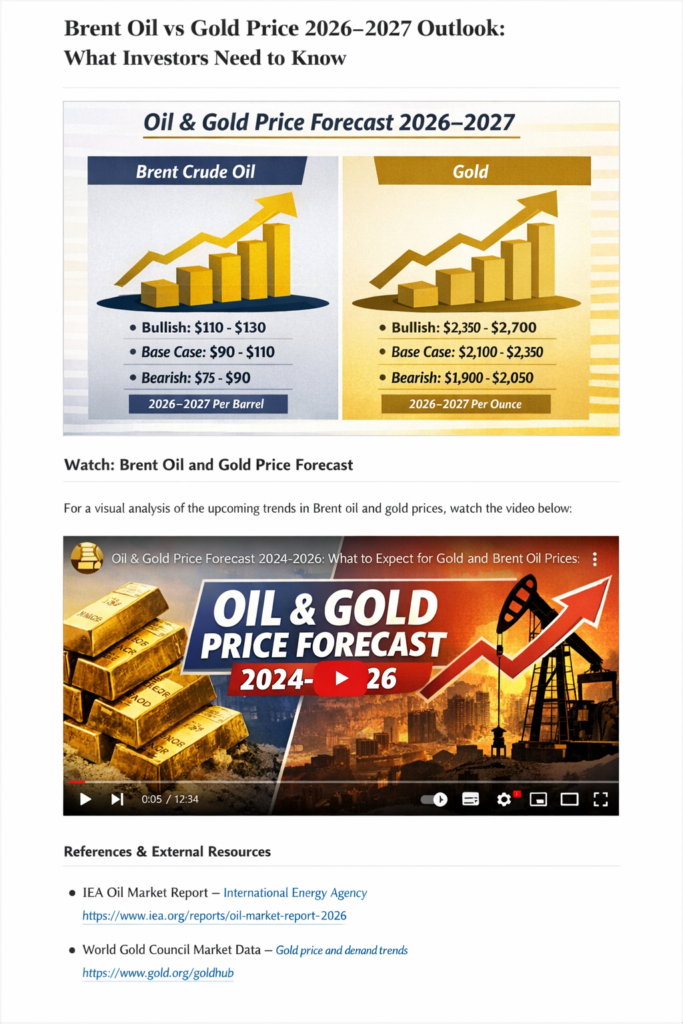
Brent Oil Price Outlook: 2026–2027
Third, based on a synthesis of forecasts from major energy analysts, here are realistic Brent oil price scenarios:
| Scenario | 2026 Price Range | 2027 Price Range |
|---|---|---|
| Base Case | $90–$110 per barrel | $95–$115 per barrel |
| Bullish (Geopolitical Risk + Supply Cuts) | $110–$130 | $120–$140 |
| Bearish (Global Slowdown + Renewables Uptick) | $75–$90 | $80–$95 |
For example, if conflict escalates in oil‑producing regions, Brent could surge beyond $120 per barrel. On the contrary, global economic slowdown—especially in Asia—could soften demand and prices.
Furthermore, analysts at energy consultancies such as Rystad Energy and Wood Mackenzie highlight that if EV adoption accelerates faster than expected, oil price peaks could moderate, especially post‑2027.
In my experience, oil markets tend to overreact in the short term due to geopolitical headlines, but prices usually stabilize once supply adjustments begin. This means investors should be cautious about chasing price spikes without considering longer-term fundamentals.
What Influences Gold Prices?
Fourth, gold prices move based on different fundamentals. Because gold is seen as a safe‑haven asset, its price tends to rise when:
- Inflation surges
- Interest rates fall
- Currency uncertainty increases
- Geopolitical risk rises
Unlike oil, gold carries no yield, so its relative attractiveness increases when real interest rates are negative. Central banks around the world—including the Reserve Bank of Australia (RBA) and the U.S. Federal Reserve—impact gold price movements through monetary policy.
For current gold market data, visit the World Gold Council.
Gold Price Outlook: 2026–2027
Fifth, considering macroeconomic trends and safe‑haven demand, here are projected gold price ranges:
| Scenario | 2026 Price Range | 2027 Price Range |
|---|---|---|
| Base Case | $2,100–$2,350 per ounce | $2,150–$2,500 |
| Bullish (Inflation + Geopolitical Risk) | $2,350–$2,700 | $2,500–$3,000 |
| Bearish (Higher Real Rates + Strong USD) | $1,900–$2,050 | $1,950–$2,150 |
Notably, during periods of uncertainty—such as financial stress or inflation spikes—gold often strengthens beyond base forecasts. For example, between 2020 and 2021, gold surpassed $2,000 due to COVID‑19 economic turmoil.
Personally, I see gold as more of a risk management tool than a return generator. During uncertain periods, it often performs well, but relying solely on gold for growth can limit overall portfolio performance.
Gold is often seen as a safe-haven asset during uncertain times. You can also explore how this affects investments in our guide on property vs stocks in Australia.
Comparing Brent Oil and Gold as Investment Assets
Sixth, both commodities can be part of a diversified portfolio—but they serve different strategic purposes:
- Brent Oil is more tied to economic growth and industrial demand.
- Rising prices often correlate with stronger economic activity.
- However, oil is vulnerable to supply shocks and policy shifts (e.g., carbon taxes).
- Gold is primarily a hedge.
- It performs better during downturns, inflation, or crisis.
- Often moves inversely to equities or real yields.
In practice, investors may allocate a portion of their portfolios to:
- Energy ETFs or futures for oil exposure
- Gold ETFs or bullion for wealth preservation
What This Means for Australian Investors
Seventh, Australians should consider how these global trends impact local markets:
- Brent Oil Price Rises → Higher fuel costs
→ Higher transportation, logistics, and inflation pressure
→ Potential for higher interest rates if inflation persists - Gold Price Strength → Increased demand for gold as a hedge
→ Potential inflows into gold‑related investments
Furthermore, the Australian dollar (AUD) often moves with commodity prices. For example, if oil prices surge and global risk aversion rises, AUD could weaken against USD, which in turn supports gold prices.
From what I’ve observed, the most resilient portfolios are those that combine both growth-driven assets like oil and defensive assets like gold. Relying too heavily on one side often increases risk during unexpected market shifts.
Conclusion
In conclusion, both Brent oil and gold prices are poised to play major roles in global markets throughout 2026 and 2027. First, Brent oil is likely to remain sensitive to geopolitical risks and supply dynamics, with base forecasts in the $90–$115 per barrel range. Second, gold—driven by inflation and safe‑haven demand—is expected to trade around $2,100–$2,500 per ounce in typical scenarios.
Finally, investors should monitor key indicators such as central bank policies, geopolitical developments, and global demand trends. By doing so, they can position portfolios to balance growth and protection in a volatile market environment.
Frequently Asked Questions (FAQ)
Which is a better investment in 2026, Brent oil or gold?
It depends on market conditions. Brent oil performs better during economic growth, while gold is more effective as a safe-haven asset during uncertainty and inflation.
What is the Brent oil price forecast for 2026 and 2027?
Analysts expect Brent oil to range between $90–$115 per barrel under normal conditions, with potential upside above $120 if geopolitical risks increase.
Why do gold prices rise during economic uncertainty?
Gold is considered a safe-haven asset, so investors tend to buy it when inflation rises, currencies weaken, or financial markets become unstable.
How do oil prices affect the Australian economy?
Higher oil prices increase fuel and transport costs, contributing to inflation and potentially leading to higher interest rates in Australia.
What is the best strategy for investing in commodities?
A balanced approach is recommended, combining exposure to growth assets like oil and defensive assets like gold to manage risk effectively.